
Blog
- Home
- /
- Blog
What Is Graphite Iron and Where Is It Used?
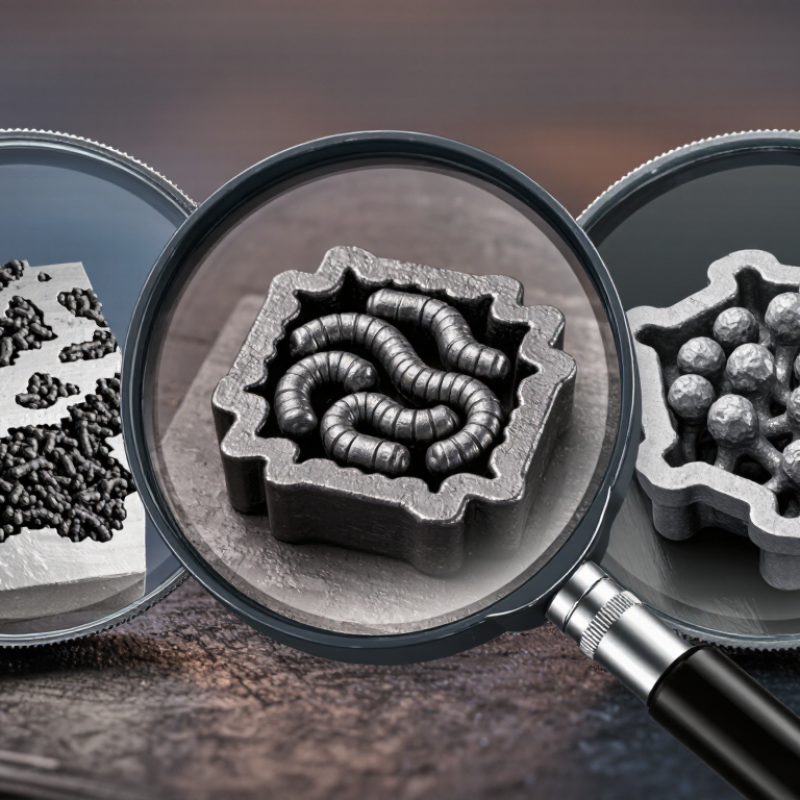
Graphite Iron is not one uniform alloy. It is a practical family of cast irons defined by graphite shape, matrix structure, and manufacturing control. Gray iron contains flake graphite. Ductile iron contains rounded graphite nodules. Compacted graphite iron sits between them. The difference is visible under a microscope, yet it changes how a brake disc, pump housing, or engine block performs.
The World Foundry Organization reported global casting production of about 109.7 million tonnes in 2022. Iron-based castings represented a major share of that output, supporting transportation, construction, energy, and industrial equipment. The U.S. Geological Survey also identifies graphite as a strategically important industrial mineral, with demand linked to metallurgy, batteries, refractories, and advanced manufacturing. These figures do not measure Graphite Iron directly. That limitation matters. Market labels are often inconsistent.
John R. Davis, a respected ASM International author on cast irons, explained the central engineering idea: “Ductile iron is a family of materials, not a single material.” This statement remains useful. Grade selection depends on strength, damping, wear resistance, machinability, and production cost. Gray iron may absorb vibration well. Ductile iron can combine strength with useful elongation. Compacted graphite iron offers a careful compromise for thermal and mechanical loads.
The material is not automatically superior. It can fail when chemistry, inoculation, cooling rate, or nodularity is poorly controlled. That uncomfortable detail deserves attention. This article examines what Graphite Iron means, how its graphite forms, and where engineers use each structure. Standards such as ASTM A48, ASTM A536, and ASTM A842 provide essential reference points, but real performance still depends on process discipline and inspection.
Chemical Composition: 2.1–4.0% Carbon and 1.8–3.0% Silicon
What Is Graphite Iron and Where Is It Used?
Graphite iron is a cast iron in which much of the carbon appears as graphite. Its carbon content commonly ranges from 2.1% to 4.0% by mass. Silicon usually falls between 1.8% and 3.0%. These elements strongly influence casting behavior, hardness, and machinability. Carbon supports graphite formation, while silicon encourages carbon to separate from the iron matrix. The result can be a material that absorbs vibration and conducts heat effectively. That matters in practical parts.
The chemistry alone does not define the final grade. Cooling speed, section thickness, melt treatment, and minor elements also change graphite shape. Flakes often suit vibration-damping housings and machine bases. Nodular graphite can provide better strength for pipes, hubs, and heavy-duty components. Some engines, pumps, and brake parts use graphite-containing iron for its thermal stability. I have seen thin cast sections cool too quickly and develop unwanted hard areas. This is easy to overlook. Foundry technicians therefore check thermal analysis, test coupons, and finished microstructures rather than trusting the percentage range alone. The stated composition is a starting point, not a guarantee. Tensile strength, wear resistance, and machining results must match the actual service conditions.
Graphite Morphology: Flakes, Nodules, and Compacted Particles
Graphite iron is a family of cast irons whose performance depends heavily on graphite morphology. The carbon is not distributed randomly. It forms flakes, nodules, or compacted particles within a steel-like matrix. This shape controls strength, vibration damping, machinability, and fracture behavior. Small details matter.
Flake graphite iron contains thin, sharp-edged graphite plates. These flakes interrupt the metallic matrix and create local stress concentrations. The material therefore offers excellent vibration damping and thermal conductivity, but lower tensile strength. It is commonly used for machine bases, brake components, engine blocks, and housings. Flake spacing, size, and orientation can vary through one casting. That variation sometimes receives too little attention.
Nodular graphite iron forms rounded particles, usually called nodules. Their smooth shape reduces stress concentration and supports higher strength and ductility. Engineers use this morphology for pipes, suspension parts, pressure components, and heavy-duty machinery. Compacted graphite iron lies between flakes and nodules. Its short, thick, interconnected particles provide better strength than flake iron while retaining useful thermal performance. It suits engine heads, exhaust components, and other parts facing heat and mechanical loads.
The matrix still matters. Ferrite improves ductility, while pearlite increases strength and hardness. Casting temperature, cooling rate, chemical balance, and inoculation influence the final structure. A polished cross-section examined under a microscope can reveal defects invisible on the surface. Even then, morphology alone cannot predict service life. Load cycles, section thickness, machining damage, and heat exposure must be considered. Metal selection is rarely perfect on the first pass.
Grade Benchmarks: ASTM A48 Classes 20–60 and ISO 1083 Ductile Iron
What Is Graphite Iron and Where Is It Used?
Graphite iron describes cast irons whose carbon forms graphite within a metallic matrix. Its behavior depends on graphite shape, matrix structure, section size, and heat treatment. Gray iron contains flake graphite, supporting vibration damping and economical machining. It appears in machine bases, brake housings, pump bodies, and engine components. Ductile iron uses rounded graphite nodules, improving tensile strength and toughness. The difference is visible in fracture surfaces and measurable through metallurgical testing.
ASTM A48 Classes 20 through 60 classify gray iron mainly by minimum tensile strength, expressed in ksi. Class 20 targets 20 ksi, while Class 60 targets 60 ksi under specified test conditions. Higher classes may support thinner or more heavily loaded sections, but casting geometry still matters. Foundries commonly test separately cast bars, and those results may not represent every wall thickness. That limitation matters. A drawing should not treat the class number as a complete design calculation.
ISO 1083 uses a different grading language for ductile iron. A grade marked 400-15 generally indicates 400 MPa minimum tensile strength and 15 percent elongation. Grades such as 500-7 and 600-3 provide greater strength with less ductility. The trade-off becomes important near impact, pressure, or fatigue-sensitive service. An ASTM A48 Class 60 casting is not automatically equivalent to ISO 1083 grade 600-3. They describe different graphite forms, test systems, and performance expectations. A practical review should confirm the grade, specimen location, hardness, microstructure, and service loads. Simple comparisons can fail.
What Is Graphite Iron and Where Is It Used? - Grade Benchmarks: ASTM A48 Classes 20–60 and ISO 1083 Ductile Iron
| Standard / Grade | Iron Type | Minimum Tensile Strength | Minimum Elongation | Graphite and Matrix Characteristics | Typical Applications |
|---|---|---|---|---|---|
| ASTM A48 Class 20 | Gray cast iron | 20 ksi (138 MPa) | Not specified | Flake graphite; commonly ferritic or ferritic–pearlitic matrix. Good vibration damping and machinability. | Light-duty housings, covers, brackets, machine bases, and general castings where high tensile strength is not required. |
| ASTM A48 Class 30 | Gray cast iron | 30 ksi (207 MPa) | Not specified | Flake graphite with a balanced strength, damping, thermal conductivity, and machinability profile. | Pump bodies, gear housings, brake components, engine components, and moderately loaded structural castings. |
| ASTM A48 Class 35 | Gray cast iron | 35 ksi (241 MPa) | Not specified | Flake graphite, generally with a higher pearlite content than lower-strength classes. | Cylinder blocks, flywheels, manifolds, machine-tool parts, and wear-resistant housings. |
| ASTM A48 Class 40 | Gray cast iron | 40 ksi (276 MPa) | Not specified | Flake graphite in a predominantly pearlitic matrix; higher strength but lower ductility than softer grades. | Industrial machinery frames, pressure-retaining castings, brake drums, pulleys, and heavily loaded housings. |
| ASTM A48 Class 45 | Gray cast iron | 45 ksi (310 MPa) | Not specified | Fine flake graphite and a strong pearlitic matrix are typically used to achieve higher tensile strength. | Heavy-duty machine components, high-load housings, bases, and wear-prone industrial castings. |
| ASTM A48 Class 50 | Gray cast iron | 50 ksi (345 MPa) | Not specified | High-strength flake-graphite iron; usually requires controlled graphite size, distribution, and pearlitic matrix. | High-load machine bases, gear cases, structural frames, and components exposed to repeated mechanical loading. |
| ASTM A48 Class 55 | Gray cast iron | 55 ksi (379 MPa) | Not specified | Very high-strength flake-graphite iron with a predominantly pearlitic matrix; relatively low ductility. | Specialized heavy-duty castings, compact machine components, and high-load wear applications. |
| ASTM A48 Class 60 | Gray cast iron | 60 ksi (414 MPa) | Not specified | Highest listed ASTM A48 tensile class; fine flake graphite and a strongly pearlitic matrix are generally required. | Highly loaded industrial castings where damping and compressive strength are important and ductility is limited. |
| ISO 1083 400-15 | Ductile cast iron | 400 MPa (58 ksi) | 15% | Nodular graphite, normally in a predominantly ferritic matrix; good ductility and impact resistance. | Pipe fittings, brackets, pressure-containing parts, housings, and general engineering components. |
| ISO 1083 450-10 | Ductile cast iron | 450 MPa (65 ksi) | 10% | Nodular graphite with a ferritic–pearlitic matrix, providing a useful balance of strength and ductility. | Automotive and industrial components, hubs, covers, levers, and moderately stressed castings. |
| ISO 1083 500-7 | Ductile cast iron | 500 MPa (73 ksi) | 7% | Nodular graphite with a more pearlitic matrix than lower-strength grades; higher strength with moderate ductility. | Gears, axle components, brackets, machinery parts, and pressure-bearing components. |
| ISO 1083 600-3 | Ductile cast iron | 600 MPa (87 ksi) | 3% | Nodular graphite in a predominantly pearlitic matrix; suitable for higher mechanical loads. | Crankshafts, heavy-duty hubs, gear components, structural connectors, and high-load machinery parts. |
| ISO 1083 700-2 | Ductile cast iron | 700 MPa (102 ksi) | 2% | High-strength nodular graphite iron, generally with a predominantly pearlitic matrix and limited elongation. | Heavy-duty gears, shafts, suspension parts, highly loaded housings, and structural castings. |
| ISO 1083 800-2 | Ductile cast iron | 800 MPa (116 ksi) | 2% | Very high-strength nodular graphite iron, typically with a strong pearlitic matrix and low elongation. | High-load drivetrain, machinery, and structural components requiring high tensile strength in cast form. |
Note: ASTM A48 class numbers indicate the minimum tensile strength in ksi for gray cast iron. ISO 1083 grade designations such as 400-15 indicate the minimum tensile strength in MPa followed by the minimum elongation percentage. Actual properties depend on casting section size, test location, heat treatment, graphite morphology, and production conditions.
Production Controls: Inoculation, Magnesium Treatment, and ASTM A247
What Is Graphite Iron and Where Is It Used?
Graphite iron contains carbon in visible graphite particles within an iron matrix. Its properties depend on graphite shape, size, distribution, and matrix structure. Production control begins before pouring. Inoculation adds selected materials to encourage fine, evenly distributed graphite. Poor timing can reduce its effect. Excessive inoculation may also create unwanted inclusions or dross.
Magnesium treatment changes graphite into compacted or nodular forms. The treatment must match the melt temperature, chemistry, and reaction time. Too little magnesium can leave irregular graphite. Too much may increase carbides, shrinkage risk, or surface defects. ASTM A247 provides a structured method for rating graphite form, distribution, and size through metallographic examination. It is valuable for quality checks, but it does not define every mechanical property. Tensile strength and impact performance require separate testing.
Tips: Cut and polish samples carefully before comparison. A rough preparation can hide small graphite particles. Check treatment records beside the microstructure. This often reveals process drift. Remember that one field of view cannot represent an entire casting. Even experienced operators can overinterpret attractive images. Repeating the examination is slower, but usually more reliable.
Industrial Uses: Brake Rotors, Engine Blocks, Pipes, and 1,000 MPa Grades
Graphite iron describes cast iron containing carbon in graphite form. Its shape controls performance. Flake graphite improves vibration damping and thermal conductivity, while nodular graphite increases toughness. The American Foundry Society reported that U.S. metalcasting output exceeded 10 million tons in recent industry assessments. That scale reflects continuing demand for engineered iron components.
Brake rotors commonly use gray cast iron. Flakes spread heat and reduce squeal during repeated braking. Engine blocks also use graphite iron because it absorbs vibration and tolerates high temperatures. In heavy equipment, ductile iron pipes provide pressure resistance and long service life. The U.S. Environmental Protection Agency’s 2023 Drinking Water Infrastructure Needs Survey estimated over 625 billion dollars in required investment during the next 20 years. Much of that renewal work involves buried water infrastructure.
High-strength grades require more careful classification. Austempered ductile iron can exceed 1,000 MPa tensile strength under ASTM A897 requirements. Its graphite nodules, alloy chemistry, and heat treatment must work together. It is not simply “strong gray iron.” That shortcut causes design errors. Engineers should verify tensile strength, elongation, fatigue data, and section thickness using certified test results. ISO 2531 and AWWA C151 provide relevant ductile-iron pipe requirements, while SAE J431 supports automotive gray-iron specifications. Real castings still vary. Mold filling, cooling rate, and machining can change the final result.