
Colourinn Industries – Textile & Dyes Auxiliaries Manufacturer & Exporter

Blog

  1. Home
  2. /
  3. Blog

How to Source Plant Based Laundry Detergent in Bulk?

Sourcing Plant Based Laundry Detergent in bulk requires more than comparing prices on a supplier spreadsheet. Buyers must examine ingredients, cleaning performance, packaging, production capacity, and delivery reliability. A detergent may sound sustainable, yet its formula can contain unclear surfactants or excessive fragrance. Clear documentation matters.

Experienced procurement teams usually request a full ingredient list, safety data sheet, technical specification, and recent test reports. They also check whether plant-derived ingredients are supported by traceable documentation. Certifications can help, but they should not replace independent questions. Ask who issued the certificate, when it expires, and which ingredients it covers.

Start with a practical product brief. Define the detergent format, target stains, fragrance preference, dosage, packaging size, and expected monthly volume. Then compare samples under similar washing conditions. Use muddy cotton, oily kitchen cloths, and cold-water cycles. Small details reveal important differences.

Do not trust the first sample.

Bulk sourcing also involves factory assessment. Review quality-control procedures, batch records, filling accuracy, and complaint handling. Confirm minimum order quantities, lead times, payment terms, and shipping responsibilities before signing. A low unit price can become expensive when cartons arrive damaged or production is delayed.

Sustainability claims need careful review. Plant-based content, recyclable packaging, biodegradability, and wastewater considerations are separate issues. Suppliers should explain each claim with measurable evidence. Regional labeling and chemical requirements must also be checked with qualified professionals.

A reliable supplier relationship develops through repeated testing and honest communication. Mistakes may still happen. The goal is to identify them early, document decisions, and improve the sourcing process before scaling orders.
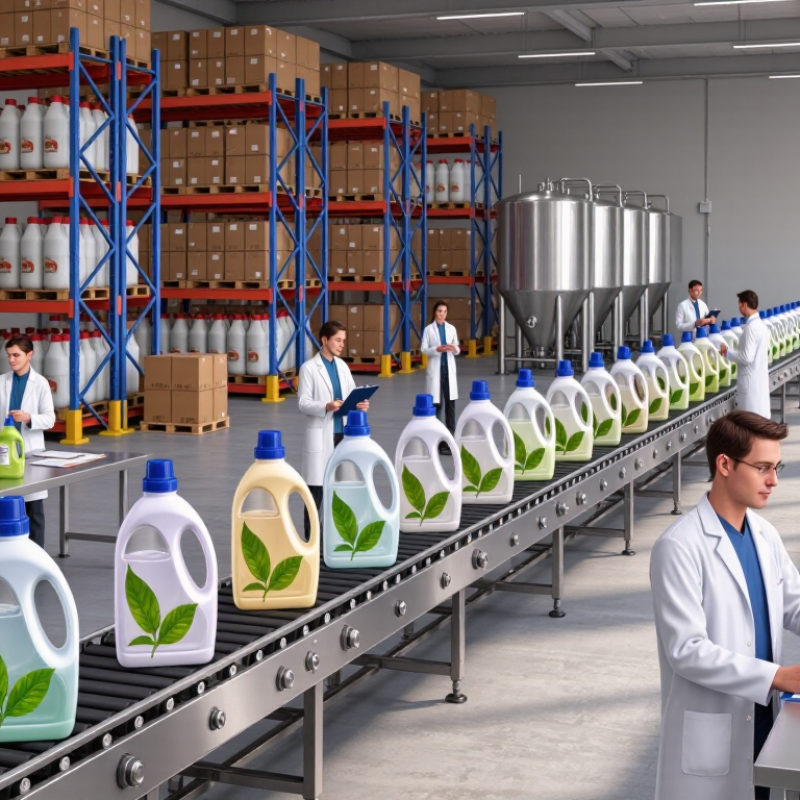
How to Source Plant Based Laundry Detergent in Bulk?

Set a Biobased Specification: USDA’s Laundry Detergent Threshold Is 53%

How to Source Plant Based Laundry Detergent in Bulk?

A strong bulk specification should begin with biobased content, not vague “natural” language. The USDA BioPreferred Program sets a 53% minimum biobased content threshold for laundry detergents. This figure is measured through ASTM D6866 carbon testing, not supplier claims. USDA’s product catalog also covers more than 16,000 certified biobased products, showing that verification is commercially practical.

Ask each manufacturer for a current certificate of analysis, biobased-content test report, ingredient disclosure, and batch traceability records. Check active matter, cleaning performance, water hardness tolerance, fragrance allergens, and preservative systems. Plant-derived surfactants can still perform poorly in cold water. That detail is easy to miss. Industry research from Grand View Research continues to identify concentrated and liquid formats as important laundry detergent segments, supporting lower-water, higher-efficiency bulk formulas. However, market growth does not guarantee better sourcing.

Tips: Request a pilot batch before signing a volume contract. Test it on cotton, synthetics, and heavily soiled workwear. Compare dosage against the supplier’s technical sheet. Confirm whether the 53% figure applies to the finished detergent, not only selected ingredients. A product may pass the threshold yet disappoint users through residue, weak fragrance control, or excessive foam. I would also review packaging weight, pallet stability, and storage temperature before approving a full shipment.

Shortlist Suppliers Using ASTM D6866 Testing and ISO 9001 Records

How to Source Plant Based Laundry Detergent in Bulk?

Shortlist Suppliers Using ASTM D6866 Testing and ISO 9001 Records

Plant based does not automatically mean fully renewable. ASTM D6866 measures biobased carbon through radiocarbon analysis, not cleaning performance or ingredient safety. Request a current laboratory report for the exact detergent formula. Check its sample code, test date, result, and laboratory accreditation. A supplier claiming “100% plant based” without this evidence deserves questions.

ISO’s 2022 Survey reported 1,265,216 valid ISO 9001 certificates worldwide. That number shows broad adoption, but certification alone proves little about a specific product. Ask for the certificate scope, manufacturing address, expiry date, and latest audit status. The site making your bulk order should match the recorded site. Review batch records, viscosity checks, fragrance controls, and retained samples. Small details reveal operational discipline.

Tips: Compare three suppliers using the same checklist. Ask for ASTM D6866 results by formula, not marketing claims. Request a pilot batch before signing a large contract. Test washing performance in cold water and hard water. Keep one unopened sample for later comparison. ISO paperwork can be polished. Production can still vary. I would also inspect packaging damage after transport, because “sustainable” detergent is not useful if leaking cartons create waste.

Compare MOQ and Total Cost per Wash at a 30–40 mL Dosage

How to Source Plant Based Laundry Detergent in Bulk?

When sourcing plant based laundry detergent, compare cost per wash rather than carton price. A 30–40 mL dosage makes this calculation practical. For example, a 1-liter bottle provides about 25 to 33 washes. If the liquid costs $3.20 per bottle, the product cost is roughly $0.10 to $0.13 per wash.

MOQ can change the result quickly. A supplier may offer a lower price at 1,000 liters, but that order ties up cash and storage space. Ask for pricing at several levels, such as 200, 500, and 1,000 liters. Include bottles, labels, inner cartons, pallets, freight, testing, and import charges in the landed cost. A low MOQ may cost more per unit, yet it can reduce waste during early market testing.

Request a recent specification sheet, ingredient statement, safety documentation, and batch quality records. Check whether the recommended dosage works in cold water and different water hardness levels. Test the detergent on cotton, towels, and lightly stained workwear. Real testing matters.

Do not trust a single wash-count claim.
Record the exact dose used.

A common mistake is comparing a 30 mL claim with a competitor’s 40 mL requirement. That creates a misleading price advantage. I would also leave room for imperfect dispensing, because household users rarely measure perfectly. Recalculate the total cost per wash after a small pilot order, not only from the supplier’s quotation.

Validate Cleaning Performance with AATCC Laundering Test Methods

When sourcing plant-based laundry detergent in bulk, cleaning claims need evidence beyond ingredient lists. Ask suppliers for batch records, safety documentation, and recent performance data. Then run controlled laundering trials with a qualified textile laboratory. A familiar white shirt is not enough.

AATCC laundering test methods can make comparisons more reliable. AATCC TM61 helps evaluate colorfastness during accelerated laundering, while AATCC TM135 measures dimensional changes after washing. For stain removal, select a suitable soil-release or detergency procedure through the laboratory. Test common soils, such as cooking oil, coffee, grass, and body soil. Keep water hardness, temperature, detergent dose, fabric type, and wash cycles consistent. Record visual ratings and instrumental readings when available. Plant-based does not automatically mean effective. It may also behave differently in cold water or hard water. That part is often overlooked.

Tips: Request samples from at least three production batches. Wash each sample with identical loads and detergent doses. Include a standard reference detergent for comparison. Check residue on dark fabric and foam behavior in high-efficiency machines. Review the current AATCC method scope before purchasing a test, because methods can change. I would also repeat the trial after storage. A detergent can perform well in a fresh sample, yet lose strength after several months. That weakness deserves attention before placing a large order.

How to Source Plant Based Laundry Detergent in Bulk? - Validate Cleaning Performance with AATCC Laundering Test Methods

Bulk sourcing comparison matrix with plant-derived formulation indicators, purchasing parameters, and standardized textile-laundering validation checkpoints
Formula Code Plant-Derived Surfactant System Plant-Derived Content
% of total formula
Recommended Dose
per 4.5 kg load
pH of 1% Solution AATCC TM130
Oily Stain Release
5 = best
AATCC TM130
Particulate Soil Release
5 = best
AATCC TM61
Colorfastness After 3 Accelerated Cycles
Low-Temperature Performance
20°C wash
Bulk Format Indicative MOQ Typical Lead Time Recommended Validation Action
PB-LD01 Alkyl polyglucoside, methyl ester sulfonate, and soapnut-derived saponins 76% 50 mL 8.1 4.1 / 5 4.0 / 5 Grade 4–5; no major shade change observed Strong; suitable for routine mixed loads 20 L pail; 200 L drum; 1,000 L IBC 1 IBC 4–6 weeks Confirm oily-stain removal at the target dose using AATCC TM130 and verify fabric compatibility with AATCC TM135.
PB-LD02 Alkyl polyglucoside and coconut-derived anionic surfactant 69% 55 mL 8.4 4.0 / 5 4.2 / 5 Grade 4–5; low visible redeposition Good; effective on everyday particulate soil 25 kg pail; 200 kg drum; 1,000 kg IBC 500 kg 5–7 weeks Use AATCC TM130 for stain-release screening and include a whiteness or reflectance measurement for repeated-wash comparison.
PB-LD03 Rapeseed methyl ester sulfonate, alkyl polyglucoside, and citrate builder 82% 45 mL 8.7 4.3 / 5 4.1 / 5 Grade 4–5; stable after accelerated laundering Very good; strong cleaning at reduced temperature 20 L pail; 200 L drum; 1,000 L IBC 1,000 kg 6–8 weeks Prioritize 20°C and 30°C wash trials, then use AATCC TM135 to monitor dimensional changes after repeated laundering.
PB-LD04 Soap-based vegetable surfactants with alkyl polyglucoside and sodium citrate 88% 60 mL 9.2 3.6 / 5 4.0 / 5 Grade 4; slight dulling may occur on heavily soiled whites Moderate; benefits from warm water and adequate rinsing 25 kg pail; 200 kg drum 500 kg 4–6 weeks Check oily soil removal, rinse residue, and whiteness retention before approving for high-volume commercial use.
PB-LD05 Alkyl polyglucoside, amino-acid-based surfactant, and plant-derived chelating agent 74% 50 mL 7.8 4.0 / 5 4.1 / 5 Grade 4–5; suitable for colored textiles Good; balanced performance on mixed fibers 20 L pail; 200 L drum; 1,000 L IBC 1 IBC 5–7 weeks Validate color retention with AATCC TM61 and assess pH-sensitive or delicate textile compatibility separately.
PB-LD06 Plant-derived nonionic surfactants with enzyme package and sodium citrate builder 64% 40 mL 8.3 4.4 / 5 4.3 / 5 Grade 4–5; no significant color transfer in screening Very good; effective at standard and low temperatures 20 L pail; 200 L drum; 1,000 L IBC 1,000 kg 6–8 weeks Confirm enzyme stability during storage, perform AATCC TM130 testing, and monitor odor and viscosity after accelerated aging.
PB-LD07 Alkyl polyglucoside and coconut-derived amphoteric surfactant 71% 55 mL 7.6 3.9 / 5 4.2 / 5 Grade 4–5; low risk of visible dye loss Good; suitable for frequent garment washing 25 kg pail; 200 kg drum; 1,000 kg IBC 500 kg 4–6 weeks Evaluate foam behavior in the intended washer type and confirm cleaning performance at the proposed commercial dose.
PB-LD08 High-active methyl ester sulfonate with alkyl polyglucoside and sodium carbonate 67% 35 mL 9.5 4.2 / 5 4.4 / 5 Grade 4; alkalinity should be checked for sensitive dyes Very good; high soil removal at standard temperature 20 kg pail; 200 kg drum; 1,000 kg IBC 1,000 kg 6–9 weeks Use AATCC TM61 for accelerated colorfastness and include AATCC TM79 pH testing for finished textile compatibility.
Testing note: AATCC TM130 is used to compare oily and particulate stain-release performance, AATCC TM61 is an accelerated laundering procedure for evaluating colorfastness to repeated laundering, AATCC TM135 is used to assess dimensional changes in fabrics after home laundering, and AATCC TM79 measures the pH of textile materials. Results can vary with water hardness, washer type, load size, water temperature, fabric construction, stain age, detergent dose, and rinse conditions; supplier qualification should therefore include independent laboratory confirmation using the buyer’s intended wash program.

Confirm SDS, UN Packaging, Shelf Life, and Lot Traceability Compliance

Sourcing plant-based laundry detergent in bulk requires more than checking the ingredient list. UNEP’s Global Chemicals Outlook II projects global chemical production will nearly double by 2030 from 2017 levels. That growth makes documentation discipline increasingly important.

Request a current Safety Data Sheet before approving samples. Check all 16 sections, including hazard classification, transport information, storage conditions, and emergency measures. “Plant-based” does not automatically mean non-hazardous. Confirm the SDS matches the exact formula, concentration, and destination market. Do not guess.

For dangerous-goods shipments, verify the correct UN packaging code and testing certificate. Packaging should withstand stacking, vibration, leakage, and temperature changes during ocean transport. Ask for closure specifications and container compatibility records. The UN Model Regulations provide the technical framework, while local transport rules may add requirements. Packaging mistakes can damage an otherwise compliant shipment.

Shelf life needs evidence, not a printed promise. Review real-time stability data, accelerated testing, preservative performance, odor changes, viscosity, and cleaning efficacy. The U.S. EPA Safer Choice Standard emphasizes ingredient transparency and product performance, but it does not replace stability verification. Lot traceability should connect raw-material lots, production dates, filling lines, warehouse locations, and retained samples. Request a mock recall record. Test it.

A practical weakness is relying on supplier spreadsheets alone. Independent audits and periodic document checks reduce that risk, especially when formulas change quietly. Insist on change-control notices, updated SDS files, and records that remain readable after delivery.

How to Source Plant-Based Laundry Detergent in Bulk?

Confirm SDS, UN Packaging, Shelf Life, and Lot Traceability Compliance

This sourcing checklist shows the typical number of evidence items to verify before approving a bulk supplier. SDS review covers the 16-section safety data sheet structure, while UN packaging, shelf-life, and lot-traceability checks focus on transport documentation, product stability, and recall readiness.