Top Silk Like Fabric Types for Global Buyers
Global buyers are rethinking how luxury, performance, and responsibility meet in textile sourcing. Silk Like Fabric offers a familiar sheen, fluid drape, and softer price point than natural silk. Common options include polyester satin, viscose charmeuse, acetate, nylon, and cupro. Each behaves differently under heat, moisture, abrasion, and repeated washing.
The scale of this category reflects wider fiber-market pressures. Textile Exchange’s Materials Market Report 2024 estimates that global fiber production reached 124 million tonnes in 2023. It also reports that polyester represented about 57% of total production. This figure explains why polyester-based silk alternatives remain widely available and commercially competitive. However, volume does not equal quality. A glossy surface can hide poor breathability, weak seam strength, or disappointing colorfastness. That detail deserves attention.
This guide compares the top Silk Like Fabric types for international purchasing teams. It considers hand feel, weight, drape, durability, care requirements, cost, and environmental information. Buyers should request fiber-composition testing under ISO 1833 and abrasion testing aligned with ISO 12947. Suppliers should also provide technical data sheets, production samples, and relevant certification evidence. GRS, FSC, and OEKO-TEX claims require careful verification, not casual acceptance. A label alone proves little.
There is no perfect substitute. Polyester may deliver stable color and easy care, while viscose can create a cooler, more natural hand. Acetate often drapes beautifully but may require gentler handling. These trade-offs matter when selecting fabric for dresses, linings, scarves, hospitality interiors, or performance costumes. The most reliable choice begins with the end use, not the showroom shine.
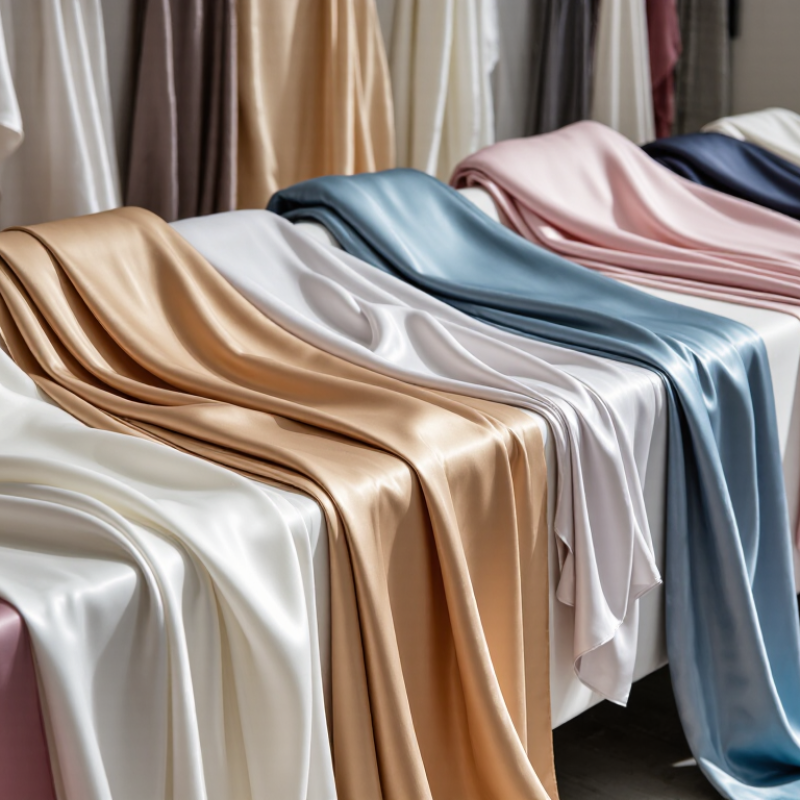
Silk-Like Fabric Classification by Fiber, Denier, GSM, and Weave
Top Silk Like Fabric Types for Global Buyers
Silk-like fabric classification starts with fiber, but fiber alone cannot predict performance. Polyester offers strong color retention, easy care, and stable pricing. Nylon often feels smoother and stretches better. Viscose or acetate can provide a softer, more fluid drape. Each option reacts differently to heat, moisture, and finishing treatments.
Denier describes filament thickness. Lower denier usually creates a lighter, softer surface, while higher denier adds strength and body.
GSM measures fabric weight per square meter. A 70 GSM lining feels very different from a 180 GSM dress fabric.
Weave changes the result again. Satin creates a glossy face, plain weave improves stability, and twill adds subtle structure. A neat classification still has limits. Finishing can temporarily change touch and shine.
Tips: Request fiber content, denier, GSM, weave details, and a physical swatch. Rub the fabric gently, hold it against light, and check recovery after folding. Compare samples after washing when possible. A shiny surface may hide weak construction. Test before ordering volume.
Experienced buyers should also inspect width, shrinkage, colorfastness, seam performance, and batch consistency. Two fabrics with identical GSM may drape differently because their yarns and densities differ. Small errors happen in specification sheets. Confirm measurements with an independent laboratory when the application is sensitive.
Polyester Satin: 50–150 g/m² and Less Than 1% Moisture Regain
For global buyers comparing silk-like fabrics, polyester satin remains a practical choice. Its smooth face, soft shine, and stable pricing suit linings, scarves, sleepwear, and decorative garments. The key specification is 50–150 g/m², which covers light, fluid satin and denser options with better coverage. A 50 g/m² fabric may feel elegant but can show transparency under strong light. A 150 g/m² fabric usually hangs with more body.
Moisture regain below 1% means polyester satin absorbs very little water from the surrounding air. It dries quickly and resists noticeable dimensional change during normal handling. However, low absorption can increase static, especially in dry climates. It may also feel less breathable than silk or cellulosic fabrics. This detail matters for warm-weather clothing. During fabric evaluations, I have found that appearance alone can mislead buyers. A glossy sample may still have weak seam performance or excessive snagging.
Tips: Request the fabric weight from several cuttings, not one edge. Ask for a moisture regain test report and confirm the testing conditions. Check opacity over a dark surface. Rub the fabric repeatedly to observe surface dulling and static buildup. Review shrinkage after washing or steaming. Small differences matter. A lightweight satin can save freight cost, yet it may require lining or careful sewing. That trade-off deserves a real sample review, not only a specification sheet.
Viscose and Lyocell: 11–14% Moisture Regain and Soft Drapability
Top Silk Like Fabric Types for Global Buyers
Viscose and lyocell deserve attention when buyers need silk-like softness without a glossy, slippery surface. Their moisture regain commonly falls between 11% and 14%, depending on fiber type, finish, and test conditions. ASTM D1909 provides standard textile testing guidance, while Textile Exchange’s 2024 Materials Market Report records global fiber production at about 124 million tonnes in 2023. This scale shows why specification control matters.
Viscose often feels fluid and cool against the skin. Lyocell usually offers a cleaner fall and stronger wet performance. A 120–160 gsm woven fabric can form soft shoulder folds, loose sleeves, and smooth skirt drape. The moisture regain helps reduce a dry, plastic-like hand. It does not make either fabric waterproof. That distinction is easy to miss.
Global buyers should request fiber content, yarn count, fabric weight, weave structure, and finishing details. Test samples after washing, not only from the cutting table. Shrinkage and fibrillation can change the surface noticeably. I would also compare identical fabric weights under the same humidity conditions. A moisture figure alone is incomplete. It cannot predict every touch experience, especially after dyeing or softening. That is where specifications need a second look.
Acetate, Nylon, and Cupro: Luster, Strength, and Care Metrics
Acetate, nylon, and cupro can all imitate silk, but their performance differs sharply. Acetate offers a glassy luster and a fluid drape. Its typical moisture regain is about 6.5% under standard conditions, so it feels less clammy than many synthetics. However, heat and abrasion can leave visible damage. Use low-temperature pressing and careful dry-cleaning guidance. The gloss is attractive, but not effortless.
Nylon provides stronger abrasion resistance and reliable stretch recovery. Its moisture regain is commonly near 4.5%, which supports quick drying but may feel less breathable in humid wear. Cupro absorbs more moisture, often reported near 11%, creating a cooler, softer hand. It also produces a deep, quiet sheen rather than acetate’s sharper reflection. Textile Exchange’s 2024 Materials Market Report places global fiber production at 124 million tonnes in 2023, with continued growth expected. That scale makes fiber selection and care labeling increasingly important for international buyers.
Test claims under controlled conditions. ISO 139 specifies textile conditioning at 20°C and 65% relative humidity. ASTM D5034 can measure tensile strength, while ISO 6330 supports repeatable home-laundering procedures. Compare fabric weight, seam slippage, pilling, and color change after washing. A higher strength result does not guarantee better wear comfort. I have seen glossy samples pass strength checks yet fail after rough handling. That gap deserves honest review. Check shade consistency across dye lots. Also question “silk-like” descriptions without measured luster, recovery, or shrinkage data.